Defamation, The First Amendment, and Social Media

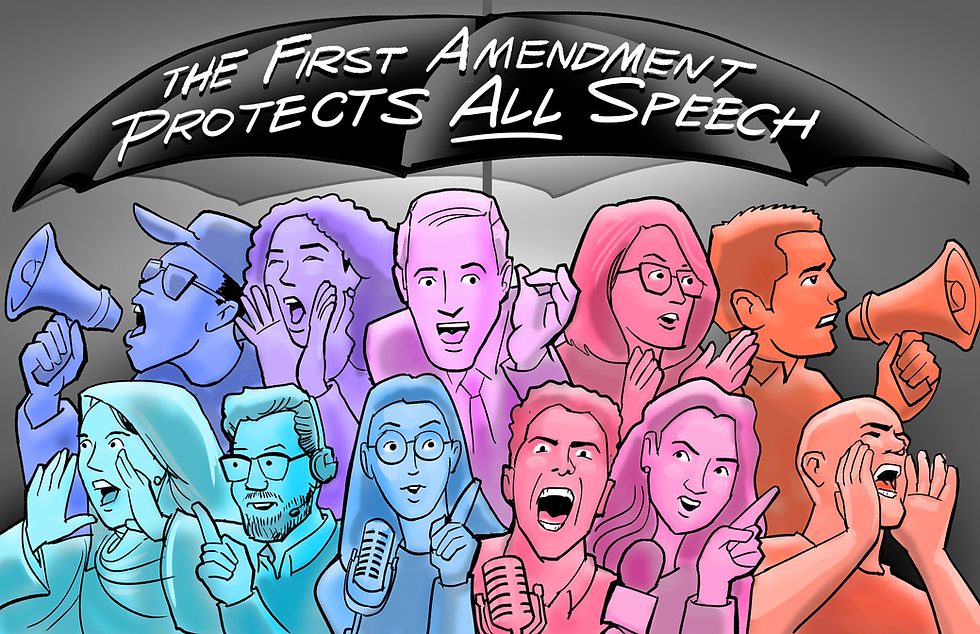
The United States is famous for its freedoms, particularly those within the First Amendment, which grants U.S. citizens the right to free speech, press, assembly, petition, and religion. The First Amendment, with its grand virtue of freedom, is incredibly well known and incredibly complex.
Furthermore, propaganda has been a staple of American politics since before the birth of the nation, whether it be via speech, news, poster, radio, television, or social media. But as

the platforms to share propaganda have grown, both in number of platforms and size of audience, the First Amendment’s freedom of speech clause has grown increasingly intricate. Libel and slander have always been present exceptions, but what qualifies as defamation? Where does opinion end and false accusations begin? Beyond that, even if a long court case commences, once the false statement has been absorbed by the public, is a retraction truly worth the effort?
Every unique instance and situation muddles together and the ruling boils down to context. Who is spoken against, who is speaking, what is the political climate at the time, and who is sitting on the bench? These are the questions that truly determine the extent of free speech.
The First Amendment | Freedom of Speech Clause
In a general verbiage, the First Amendment's freedom of speech clause prevents government abridgement of speech across the United States. However simple this may seem, it comes with intricacies. First of all, the word ‘government’ itself represents three different systems; the local, state, and federal governments. While it is implied within this clause that the lower levels of government must also guarantee this right, the Fourteenth Amendment’s due process clause provides the clarity necessary by requiring that state governments protect and honor the freedoms outlined in the entirety of the constitution.
Beyond the general idea of abridgement, the First Amendment protects against the censorship and restriction of not only the spoken and written word, but of actions which may symbolize speech, like flag burning. The highest level of speech protection typically is associated with that of political or ideological speech as well as artistic expression.
There are exceptions, as with many things in the field of law. First, there are true threats,
or statements intended to threaten violence or incite physical action. Second, there is the

exception of obscenity which must pass the Miller Test to be deemed protected. In order to pass the Miller Test the speech must not appeal to morbid, shameful, or excessive interest in sexual acts, must not be patently offensive according to state sexual conduct laws, and must lack serious literacy or connotation. Third, speech cannot be used to commit any type of fraud. Fourth, it cannot cause any immediate lawless actions. Finally, speech will not be protected if it falls under the category of defamation, or libel and slander.
Libel and Slander
Libel is a form of defamation in which there has been published false information resulting in the damage of reputation. In legal language, libel is, “false or unjustified injury to

someone's good reputation." In order to justify that press is libel it must meet at least four qualifications. It must be false information purporting as a fact, be published or communicated to a third party, fault amounting to at least negligence, and damage must occur to one’s reputation. In layman’s terms, to be considered libel, false information must be disguised as a fact and communicated to a third party due to at least negligence while causing damage to someone’s reputation. Slander is a blatant false statement, typically said orally, which defames another person. Unlike libel, damages from slander are not presumed without a lawsuit. Slander has similar qualifications as libel with the exception that instead of published word, it is spoken communication
For a statement to qualify as defamatory, it must include a false fact, not just an opinion. The difficulties of this requirement is how opinions can imply a false fact. An example of an opinion without an implied fact would be, “I dislike Mr.Smith and am glad he shut down his business.” An example of an opinion with an implied fact would be, “I dislike Mr.Smith and believe he shut down his business because of the sexual harassment that would occur there” The second opinion is assuming that sexual harassment was occurring, thus spreading false facts and damaging the reputation of Mr.Smith. Therefore, the implied fact in the opinion is defamatory but the opinion of disliking Mr.Smith is completely protected by the First Amendment.
Common examples of defamation include false accusations of sexual misconduct, intentionally false witness statements for criminal activity, publishing a review of a business or restaurant including false statements to make the business look worse, e.g. claiming they got food poisoning when they did not. In all these instances, the reputation of a person or business was harmed and the information was blatantly false.
Online Propaganda and Defamation
Defamation online still follows similar guidelines to that which is spoken or printed in papers. The complexities in this become apparent when deciding if present defamation on

social media is libel or slander. For example, it is common for TikTok videos to not only speak to the camera, but include closed captions. In this instance are the words spoken or written? This distinction changes how the defamation is viewed in court. Furthermore, defamation is considered a tort, or a civil wrongdoing for which a person can sue another party for monetary damages. This classification of a tort separates it from online harassment like cyberbullying and cyberstalking, both of which count as criminal actions in states like California, Indiana, and Connecticut. This is an important note for the realm of social media and identifying defamation. Unless the qualifications are met to be either slander or libel, it is protected under the First Amendment and may then be identified as harassment upon further inspection.
Anything that qualifies as an opinion and is posted on social media remains protected by First Amendment rights. Moreover, Section 230(c) (1) of the Communications Decency Act provides immunity to social media platforms like X, Facebook, Instagram, ect, for statements made by the users. Thus, should someone perform an act of defamation on X, the platform itself may not be sued for their actions.
Some examples of defamation on social media include YouTube videos with false claims of plagiarism against a professor, Instagram posts accusing someone of immoral conduct, and fake news stories on reddit, Quora, or similar platforms.
In terms of political propaganda, particularly on social media, should a candidate state false information about an opponent that would damage their reputation, there is a possibility of a defamation lawsuit case.
Relevant Case Law
These U.S. Supreme Court cases featuring the First Amendment continue to prove how the regulation of free speech is determined by context; the words said, the political environment at the time, and the audience. Below are 3 cases from three decades in history.
1910s sociopolitical context: World War I started in this decade, despite the nation’s original intent not to join the conflict, a letter from a German, Zimmerman, intended for Mexico changed their mind. In an effort to win the war, they established a multitude of precautions to prevent anti-war efforts from those who maintained the nation’s earlier opinions on the global conflict.
1950s sociopolitical context: Fresh from World War II, America’s economy is prosperous and the nuclear family is thriving. However, one bias was growing, and quickly. The Communist Party was demonized in the American public eye. Even a brief mention of possible communist affiliations could get an actor or politician blacklisted. This phenomenon was noted in history as the Red Scare due to the association of communism with the color red.
1960s sociopolitical context: This was the peak of the Civil Rights Movement, with African Americans gaining the ability to vote via the Voting Rights Act of 1965. The courts were moving at a progressive pace, prioritizing freedom and equality due to the success of the movement.
Schenk v United States (1910s)
Schenk v United States is established as an incredibly important case to define the limitations of the First Amendment. Schenk was a general for the Socialist Party of Philadelphia who protested the draft of World War I by handing out leaflets to men of drafting age. He argued conscription was equivalent to "involuntary servitude” and a violation of the Thirteenth Amendment. In response to his actions, Schenk was originally charged with the Espionage Act of 1917, which enacted harsh punishments to those speaking against war efforts during World War I.
When he took the case to the Supreme Court, the question at hand was if the Espionage Act of 1917 was in violation of the First Amendment. In a unanimous decision by the court, the

charges against Schenk were upheld. Chief Justice Oliver Wendell wrote the decision and established the importance of context to the protection of free speech; actions permitted during peacetime were punishable during wartime if there was a plausible situation in which they interfere with the war effort.
From this case, the court established The Clear and Present Danger Test, which argues that speech is no longer protected should it approach “creating a clear and present danger of a significant evil that Congress has power to prevent.” By this logic, Schenk's actions were in violation of this test because, should men listen and resist the draft, the nation would be put in imminent danger as there are not enough soldiers overseas to win the war.
Dennis v United States (1950s)
In the midst of the Red Scare, or the fear of Communism across America, Dennis was a
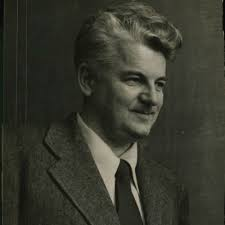
leader of the CPUSA, or the Communist Party USA which were convicted under the Smith Act of 1940, an act that made it a federal crime to knowingly advocate, abet, or teach the violent
overthrow of the United States, or organize groups with the intention to do so. Members of the party who had been advocating for socialist reforms claimed the act was a violation of the First Amendment. The Supreme Court analyzed whether the Smith Act of 1940 was a violation of freedom of speech.
In a 6-2 decision, the court decided the act did not inherently violate the First Amendment. The opinion stated there was distinction between the teaching of communist ideologies and the active advocacy of communist ideas. The advocacy created clear and present danger which constitutes prohibition of speech by the government, and allows the Smith Act of 1940 to not violate the First Amendment. They cited the gravity of consequences for the situation at hand, communist activity and possible coup plans, did not warrant an analysis of probability of success.
The court’s opinion in this case set the basis for a plethora of other cases in which they would uphold the convictions of Communist Party members throughout the 1950s.
Brandenburg v Ohio (1960s)
The case of Brandenburg v Ohio is known as a landmark supreme court case, particularly for the free speech clause of the First Amendment. In 1969, Clarence
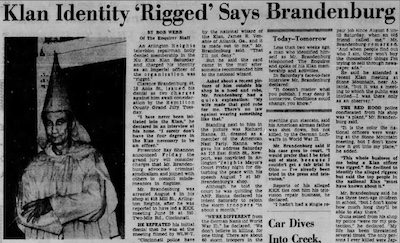
Brandenburg, a Ku Klux Klan officer, invited a news reporter to an event where he gave a speech including insulting and derogatory language of African Americans and Jews. Within his speech he also referenced future acts of “revengence” against the government. Due to his inflammatory speech, he was convicted under the Ohio Criminal Syndicalism Act, or an act prohibiting the ability to advocate, teach, or or assemble to promote violent behavior, sabotage, or terrorism as a form of political reform. What was called into question was not if Brandenburg violated this act, but if the act violated Brandenburg's right to free speech.
On June 9th, 1969, the Supreme Court decided that the Ohio Criminal Syndicalism Act was a violation of the First Amendment, and Brandenburg was free to continue his speeches and propaganda. The court wrote in their decision that the act failed to recognize if the criminalized advocacy led to definite lawless action, without this definitive, it was a violation of free speech. The court also noted that it was a violation of the Fourteenth Amendment, specifically the due process clauses which prohibits states government from depriving any one person of their constitutional rights without due process. As the state law prohibited the national right of free speech, the Ohio Criminal Syndicalism Act was violating the due process clause.
This case created the Brandenburg, or Incitement, Test, which is a two-pronged evaluation to determine whether speech is able to be prohibited. First of all, the speech must have intent, or be “directed at inciting or producing imminent lawless action.” Second of all, the speech must be “likely to produce such action.” In other words, to gain the right to prohibit speech, the speaker must intend to create lawless actions and have the power to realistically inspire said actions.
Conclusion
These fundamental Supreme Court cases exemplify the importance of context in terms of free speech protections. The Brandenburg test would have prevented both the conviction of Dennis and Schenk because there was not a large possibility either man could rally enough people to fundamental put the nation in danger. Schenk's leaflets were most likely be unable to inspire enough men who would lawlessly resist the draft to put the United States in a position to lose the war. Furthermore, with the amount of prejudice and close inspection on Communists during the Red Scare, it was unlikely that advocating for communist ideals would have resulted in the lawless action of overthrowing democracy. Therefore, both men's situations would have failed the Brandenburg test.
Even online, it's all about context. The consequences of stating an opinion vs implying a fact is all about the audience and the likelihood of a defamation lawsuit. Moving forward, be sure to take notice of both what you say online and the context under which you are speaking to avoid falling into the complex web of First Amendment protections.


Comments